




LISTEN: “Shaping God,” Epic Convo about Author Octavia Butler

Calling all feminists, womanists, afro-futurists and Octavia Butler enthusiasts. In this epic dialogue (published in Ada, a journal of gender, new media, and technology), Quirky Black Girls founder Moya Bailey and brilliant community facilitator Adrienne Maree Brown unpack the power of Butler’s Black feminist and womanist sci-fi visions in the shaping of a new world.
Octavia Butler described herself as “comfortably asocial—a hermit in the middle of Seattle—a pessimist if I’m not careful, a feminist always, a Black, a quiet egoist, a former Baptist, and an oil and water combination of ambition laziness, insecurity, certainly and drive” and is often referred to as the “grand dame of science fiction.” Her novels, which include The Parable of the Sower and Wild Seed, explore issues around race, sex and power.
Adrienne Maree Brown brings communities together through the thread of Butler’s writing in collaborative sessions that emerge around the curated content of her Octavia Butler Strategic Reader.
Reflecting on the themes in Butler’s work, Brown shares:
[W]hen I think about a lot of the work that I’ve read — Afrofuturist work — coming from other than the capitalistic democratic start that we have here in the U.S. the main thing that I pick up on is this radical collaborative energy. How communities work is with each other rather than competing against each other… I think that there’s a lot of dynamism, there’s a lot of really distinct ways that people are making their lives on the continent but when it comes to the writing and the social norms that have been put out there, there’s so much more togetherness and collaboration in it and so I feel like so much of Octavia’s role and work uplifts that in practice.
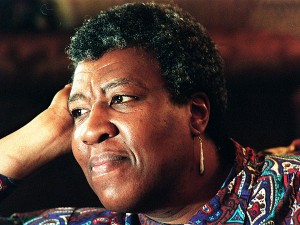
Octavia Butler
Later when asked about what lessons she has gotten from Butler’s work, Brown says:
So many of the ways I look at the world were shaped by reading her work at a formative age so thinking about relationships as something that should be open and free rather than sort of locked into — you know, it’s only going to be this one way for all time. I think that that is multiple lovers or to choose not to have multiple lovers, but the idea that a relationship is not a place of ownership but a place of choice — she did so much presenting of that. I learned a lesson about writing that is this. Octavia’s work is not the most beautifully written work by any means and there’s a lot of writers I’ve read that have much more beautiful work or are more technically gifted writers and yet the ideas she was presenting were so genius and she was able to present them in such an accessible way that it didn’t matter that she didn’t write some kind of way. And I think for me as a writer that’s been a really important lesson: to go ahead and put my work out there and not worry about perfection so much as being honest and feeling like if there’s wisdom coming I need to let it flow through me…
Listen to the full interview here (or read the full transcript).


Recent Comments
- InspiHERed By: Angelica Ross (1)
 { Wow! I loved learning more about Angelica and the work that she is doing. It's a pretty cool and innovative idea for a company. Thanks... } – Aug 18, 4:05 PM
- In Celebration of Black Love (3)
 { Wonderful story, great outcome I can relate. } – Aug 17, 2:52 PM
 { This was beautiful. I respect that you were able to embrace the parts of black culture you were raised to ignore. I hear where your... } – Aug 14, 10:51 AM
- Michael Jordan's Daughter Jasmine Jordan Posts Pic with Girlfriend (6)
 { Just to give everyone heads up Love is not Love. God is Love and true love is not known until we know God. To know... } – Aug 16, 10:43 PM
- Brittney Griner Talks New Book, Being a Role Model & More With ELIXHER (2)
 { Brittany when R the Brittany Griner clothes coming out?I am interested in purchasing a t-shirt with your likeness,the B.G.Shoe,I'm going to get the Hummingbird bow... } – Aug 15, 11:44 AM
- Older »






Submit a Comment