



The Read: For Sizakele
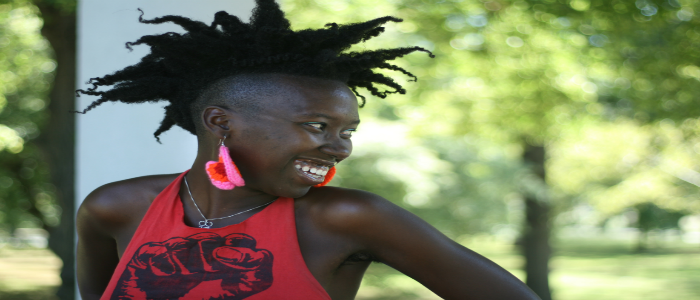

By Nitra Wisdom
Performance poet, playwright and visual artist Yvonne Fly Onakeme Etaghene has written her first novel, For Sizakele. Set for release Autumn 2014, For Sizakele explores issues of activism, self care, and gender identity through relationships between characters that will feel like your close circle of friends. We caught up with the Oakland-based author to discuss identity and language, Queer visibility in the literary community, and the importance of healing for women of color who love one another.
ELIXHER: Congratulations on the release of your first novel! For Sizakele is the product of 13 years of work. How have you seen your growth as a writer between the time you started your novel and now?
YVONNE: Thank you so much for the congratulations! Over the years, I’ve gotten clearer about how I want to tell a story. It’s not just about putting words on a page, it’s about how I paint that page with those syllables. I’ve learned that poetry is how I write, whether I’m writing an essay, fiction or a play, the language I use, the way I tell a story is through poetry. I’ve learned patience. I’ve learned that what the characters want to say takes precedence over what I want to happen—I am narrating their story, not directing it. I’ve learned to love myself in deeper ways—I have to love myself in order to believe that folks should read 66,000 of my words. As I’ve gotten to know the characters over the years, I’ve learned to be compassionate to their journeys—they are complicated, multilayered beings. I’ve learned to have fun as I write and to keep writing even when I feel like I can’t. I’ve learned to breathe, to trust the journey and follow my gut.
ELIXHER: You said you primarily identify as a poet, and that’s obvious in your novel. Is there a difference in your creative process between writing and performing your poetry and the process that went into writing For Sizakele?
YVONNE: I write in many genres, poetry is the language I use for all of them, including the non-written ones like dance and visual art. There’s isn’t really a difference, no, I just keep it real with the page and listen. To myself and to the characters. A novel is longer than most poems, therefore my writing process is longer and requires more patience. With poetry that I write about myself, I am listening to my heart and spirit and with fiction, I am listening to what the characters feel, want and have to say. I’m listening to a lot when I write fiction. If there are 5 characters, then I am listening to 5 hearts, 5 sets of desires and so on. It takes a lot of humility to purely listen with  love and compassion to what the characters are saying and how they define and describe their story.
ELIXHER: Author Sofia Samatar says that “Language is how identity interacts with the world.” Can you talk about the importance of language and dialect as they relate to your characters’ identities, and your own as a Nigerian woman in the U.S.?
YVONNE: I think primarily in English and this is the language of a colonizer. In Jamaica Kincaid’s A Small Place, she articulates how there are things she can never articulate about British exploitation of Antigua because English, the language of the colonizer, is designed to preclude the utterance of such truths. I take English and I make it say what I want. I mold and break it. I shape it. There are many languages in For Sizakele because I think immigrants and children of immigrants have so much beauty to render that sometimes it takes many languages to do so. It’s important that we speak in the language(s) our hearts sing in. As for me, words are what I do. There are some things that have no translation from language to language and that’s important to note. This is a large part of why my book has multiple languages. I need to say something and I will say it in the language that will best articulate it. I’m an Ijaw and Urhobo Nigerian woman, my people hail from the Delta. I was born in Syracuse, New York and raised between Nigeria and Syracuse. There are so many languages inside me and I honor them as best I can by creating art that reflects the inside of my bones and how my blood flows.
ELIXHER: Finding home in one another, being understood without having to explain, is one of the things that drew two of your main characters together. How do you (re)create home in your relationships within an already marginalized,”othered” community?
YVONNE: I create home by being home. I find home in the jewelry I wear, the food I eat, the poems I make, the friends I treasure, the dances I dance. I wear clothes that make me feel beautiful, comfortable, at home, sexy, sensual, love personified, me. I make home all the time. Home is a birthright. Having access to home, building home, feeling at home—these are part of our birthrights are human beings. I am drawn to people who I feel at home around and we are home to each other. We love and take care of each other. At this point, I only spend time with people who I feel at home around. Otherwise, what’s the point?
ELIXHER: You were able to wonderfully craft, as you say, “a story about Black dykes loving each other that wasn’t erotica,” and still remain true to the varied intimacies that exist in Queer women’s relationships. How do you maintain that balance as a writer?
YVONNE: Thank you so much for recognizing my intention! Erotica is lovely, I just think that the overabundance of dyke/queer women’s erotica is an example of the ways that dykes are hyper-sexualized and dehumanized. Sex, lovemaking and physical intimacy are a beautiful part of life and I wanted to express that in my book. I write stories, not caricatures and unfortunately erotica is sometimes a caricature of what deep intimacy feels and looks like. Lovemaking to me is most interesting when the spirits of those becoming physical is involved, and when it’s a metaphysical, spiritual experience.
In a lot of erotica, the point is the sex. Which is cool. Sometimes that’s what you’re in the mood for. Sometimes that’s precisely what you need. And that’s beautiful too. In For Sizakele, the sex was a part of a larger interaction, was an expression of a connection, was bodies making physicalized poetry. That’s fascinating to me. I wrote about how bodies make poetry together, how love and attraction are expressed in the context of relating to another person’s smile, story, fears, insecurities, joys. I wrote complicated sex scenes that were also simple. I maintain balance by writing multilayered scenes. For example: the touch is sexy. The gaze combined with the touch is sexy. The intimate conversation combined with the gaze and the touch is sexy. Layers. I maintain balance by writing sex scenes the way I write all my scenes—candidly and with many layers.
ELIXHER: One of the issues unearthed in For Sizakele was gender performance and presentation as a defense mechanism. It made me think about how when I am recovering from a hurt, I listen to Kanye for about a week straight. Do you feel that it’s important or necessary for women to tap into our masculine energy as part of the healing process, or does it act as an unhealthy covering of vulnerabilities?
YVONNE: Healing is different for everyone and I think what is masculine and what is feminine is relative. For instance, what’s considered feminine in the u.s. does not include the vastness of what is feminine in Nigeria. So gender/gender expression is cultural and relative, therefore even defining what actions are feminine and masculine are challenging and subjective. Sometimes as we heal, we may choose to hide, take shelter and protect ourselves and that might look like listening to hella Kanye, that might look like taking care of others to distract ourselves from our own feelings, that might look like lots of prayer, nurturing a garden, writing lots of poetry, smashing glass and tile and making a mosaic. It might look and does look a million different ways. Gender, like sexuality, is fluid. It transforms, it moves. We may need to express different parts of our gender at different times for whatever reasons, maybe no reason other than “I just feel like it.”
I don’t think being masculine or embracing masculine energy necessarily means that we’re covering up our vulnerabilities, although it can. In addition, I don’t think femininity is inherently vulnerable. It’s complicated. It’s important we breathe and give ourselves space to do what feels right and live our gender in the ways that feel right from moment to moment.
ELIXHER: The particular pain that Black women in the U.S. deal with can make it difficult for us to openly and freely love each other. Yet that kind of love is key to our survival. How do we do that without casting our pain off on one another?
YVONNE: That’s a huge question. I think self-reflection is so important. From that comes self-awareness and hopefully compassion for one’s self and then maybe compassion for those around us. I think sometimes people jump into relationships to hide from their own heartache—from ex-lover heartache, family heartache, life heartache and they don’t spend enough time just learning who they are and why they are who they are. Life is more than constantly being at the club getting drunk and high every night. Life is more than working endless hours with no time to breathe. We need time to be on our own, to take walks, to spend time with ourselves and have fun with ourselves, or just think (whether those thoughts are fun or not.) We need to not race through life but actually learn from what’s happening in our lives and to create the life we crave, hunger, yearn for. This takes time. It takes patience. We sometimes rush into the arms of busy work to hide from our own pain or confusion. Sometimes people use relationships or socializing all the time as busy work to run from themselves. It will catch up with you one day. It’s important, so incredibly important to breathe, reflect, pray (if you pray), go to the ocean or trees, write, dance, reflect, talk to your friends about what scares you. We have to actually know and love ourselves to live this life fully. And it’s a lifelong journey.
There are so many ethnicities and nationalities within the community of folks who may identify as or be seen as “Black women” in the u.s. I’m the child of Nigerian immigrants so that’s where I come from. Within my identities, I need time to figure out who I am, especially within a Black American community that has often challenged, misunderstood and/or misnamed my nationality and ethnicity. I have to make time to love and know myself when I encounter Africans who tell me I’m not African enough because of how I talk or where I was born. Self-reflection is important because now when people challenge who I am, yes, sometimes I still get annoyed or even angry but a lot of the time, I laugh, throw shade, write a dope poem about it and keep it pushing. No one can take my blood from me—I know who I am and I’m still learning who I am. It’s taken years to get here.
ELIXHER: Why is it important that we draw boundaries in our relationships, so as not to blur the lines between being our partners’ girlfriends and being their therapists?
YVONNE: I don’t like the word “boundaries”—it reminds me of borders. Which are an excuse to hurt and exclude people, to kill, to keep people in and out, to control who has access to what land. I prefer “loving parameters.” I think it’s important we take responsibility for our own journey, our own questions and our own healing. Our partners are there to support us through our healing, not be our therapists. Otherwise that puts too much of a strain on a relationship. Asking a lover to be a therapist is like using a raspberry as a paintbrush. That’s not what a lover is for. We’re strong enough to define and direct our own healing. When we take control of our healing, we strengthen our relationships instead of weakening them by placing too much pressure on them. Also, I think women and feminine folks love to process. No shade, just keeping it real. We’re naturally tender and are also taught and socialized to be sensitive and tender. Which is such a gigantic strength. But it’s important to learn where the line is between talking through something and/or over-analyzing something to the point of trying to be your lover’s therapist or make a lover your therapist. It’s about discernment, y’all.
ELIXHER: Dance, prayer, writing and sisterhood were some of the things that transformed Taylor’s healing. Along with these four things, what would your self-care kit consist of?
YVONNE: Music. A well-stocked kitchen with all my favorites so I can cook and cook and cook. Also access to lots of take out for when I don’t want to cook. Netflix. Wifi. Lavender. Mangoes. Lip gloss. Sage. Cowrie shells. Coconut oil. Homies, homies, my homies. Family, family, family. Nigerian cloth. Ocean. Redwoods. Stilettos and Timberlands.
ELIXHER: The beauty of literature, of stories, is its immortality, and its ability to feed generations of hungry souls. Long after we have gone, For Sizakele will find its way into the hands of a Nigerian immigrant dyke trying to find herself between the pages. What type of world do you envision for that woman of the future who seeks liberation through your words?
YVONNE: The beauty of literature, of stories, is its immortality, and its ability to feed generations of hungry souls. Long after we have gone, For Sizakele will find its way into the hands of a Nigerian immigrant dyke trying to find herself between the pages. What type of world do you envision for that woman of the future who seeks liberation through your words?
A world where people get to love who they want. Where no one assumes anyone’s gender or sexuality. Where room is made for complicated understandings of ethnicity and nationality. Where art and artists are respected as hella important parts of society. Where we make room for healing and taking care of ourselves. Where violence no longer exists. Where people have continuous and easy access to their homelands. I want a world where we are tender with each other and listen to each other so we can understand each other. Where we are sweet human beings to each other, not just some of the time, but all of the time.
You can pre-order the novel here. For more information about Yvonne and her work, visit: www.myloveisaverb.com. Connect with her on Twitter @MyLoveIsAVerb and subscribe to her YouTube channel: www.youtube.com/AfrocrownDiva.
Nitra Wisdom is a freelance copy editor and proofreader who is working on her first collection of short stories and personal essays. The self-described queer introverted bibliophile received her B.A. in Pan African Studies from the University of Louisville and currently lives in Atlanta, GA where she blogs about love, literature, being a wounded healer and the Divinity of Femininity at wiseedits.wordpress.com.


Recent Comments
- A Love Letter to Studs and Bois (45)
 { Thank you for such a touching and beautifully written/spoken letter, we need to start embracing each other instead for hurting each other, we all are... } – Mar 07, 2:33 PM
 { SUCH KIND WORDS-A love Letter to a Stud. I NEEDED TO READ THAT. IT NOT ONLY MADE ME FEEL RECOGNIZED, BUT ALSO MADE ME TAKE... } – Mar 07, 2:54 AM
- QWoC Chronicles: Three Countries, Two Lives, One Love (10)
 { That was beautiful. My wife and I are expats in Korea. Thank you for sharing your story. We were thinking about going back to the... } – Mar 07, 7:27 AM
 { Great article. I love learning more about you two! I'm in awe of what The Roses are able to do.
  can't wait to read... } – Mar 06, 10:54 AM
- 25 Beautiful Photos Of Black Queer Women That'll Make You Believe In Love Again (63)
 { Good Evening, Everyone. Take it from a silver fox. " Keep your dream big." Do you think when I was a little black girl growing... } – Mar 06, 11:42 PM
- Older »








Submit a Comment