




Black Is Everything: An Interview with Khaleb Brooks


Interview by Helen McDonald
Khaleb Brooks is a queer, trans artist whose first solo exhibition, “Art is Revolution,” is debuting this Sunday, June 29 in Brooklyn, NY. Through art, Brooks discusses questions of gentrification, queerness, and social change. Brooks sat down with ELIXHER to tell us more about using art to build community.
ELIXHER: How do you understand your sexuality and/or your gender identity?
KHALEB BROOKS: I guess I understand it as how I feel on a daily basis. I try not to put limits on myself. I think I did for a really long time and realized that was hard for me to cope with. So I guess just fluid, queer, fun-loving…my identity is just a reflection of self.
ELIXHER: Now, shifting a bit from self-identification…you got your BA in International Studies and Women and Gender Studies. How did you find yourself in art activism?
KB: Oh man, it’s been a journey. I feel like I’ve always been an artist and I’ve always been an activist. In my mind, my artistry is something I love to do. It’s something that’s fun. It’s something I felt that I was good at. Activism was more of a passion and a career path for me. Going to school for International Studies and Women and Gender Studies, I was really focused on creating social change on a global scale, entering different impoverished communities and developing communities and having that impact. It wasn’t until honestly last year when I graduated that I was like, “I don’t know if I can be at a desk nine to five. I don’t know if I can imagine myself in spaces where I can’t be an artist and express myself artistically.” So I just decided to mesh the two and it’s been working out pretty well.
ELIXHER: How do you see art as a way to build community? How do you see community as a space to create art?
KB: For me, art has been a part of all my experiences and development. When I was working in Costa Rica, I was working with a lot of Nicaraguan refugees and we did art therapy, art rehabilitation, understanding self through art. As well, I worked with a lot of youth doing performance poetry and just watching how people can stand up, share their stories, let everything go on stage, bawl their eyes out and have people in the community experience that, connect to that, relate to that, and then be able to have a conversation about what was just said. It’s just so powerful to me. I think that community is art, from murals to expression of identity. As far as my art personally, I don’t think any of my art is solely expression of self. I believe firmly in critical memory. I think that what I’m creating, what I’m drawing about, what I’m writing about is a reflection of my ancestry, it’s a reflection of future generations, it’s a reflection of problems that we’re all going through.
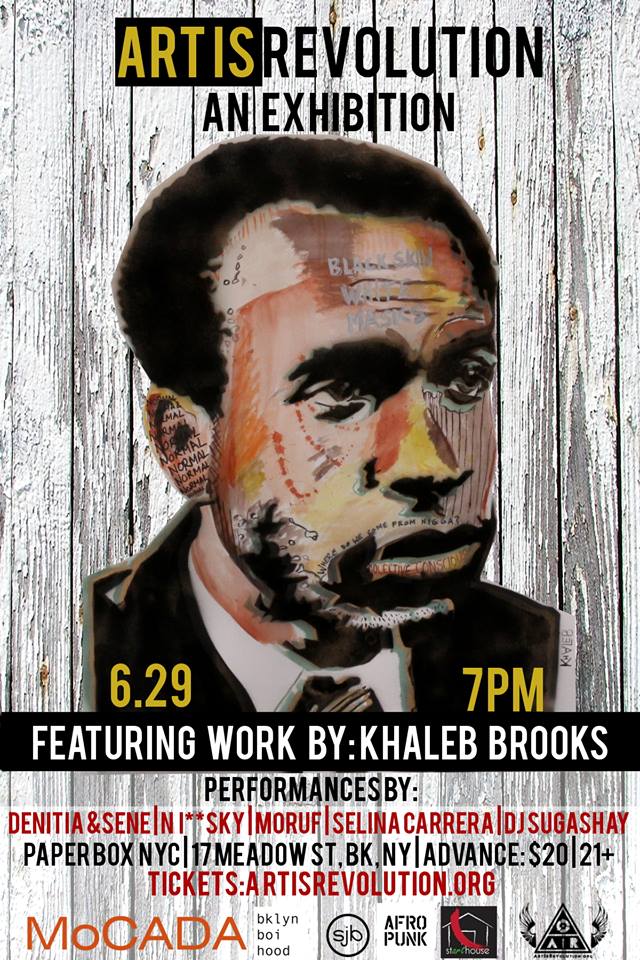 ELIXHER: Tell us about the project “Art is Revolution.” What art forms will you be using in the exhibition and what social issues will the project discuss and/or present?
KB: “Art is Revolution” is gonna be amazing! You should be there. The particular mediums are… I guess it’s mostly paintings. Oil paints, spray paint, there’s some pastel thrown in there. There’s gonna be some sculptures. There’s gonna be some alternative, engaging medium. I would say this exhibition is geared towards gentrification and post-colonialism. Gentrification, I think, for me has been one of the most pressing issues. It’s kinda been throwing itself in my face. I attempted to wrap my head around that through art and I’m really hoping to create a discourse around that. I want to create a conversation and I want to inspire people to use their own resources and talents to create their own conversations as well.
ELIXHER: How does it feel doing a solo piece versus doing things with other people?
KB: It’s exciting! I feel like I’m giving myself the opportunity to propel myself on a platform and be like, “This is me, this is my art. Take it for what it is, but I hope you like it.” Or, actually I hope people don’t like it. I hope people get angry and pissed off and they’ll talk about it. But, on the same tip of it being a solo exhibition, it’s meant to engage community. It’s my art, it’s my exhibition, but it’s everyone’s.
ELIXHER: [The show’s] going to be in Brooklyn. How do you feel like gentrification has affected your community back home in Chicago and how it’s affecting Brooklyn? Do you see similarities, especially in the way communities respond to that gentrification?
KB: Definitely. I think as a kid growing up I slowly saw the shifting culture. That was the biggest thing for me. I’m like, “What’s happening?! This spot used to be the hangout for all the poets and… now it’s a gem or now it’s just something else. A cupcake shop.” I really felt that shift and it saddened me. Then I came to Brooklyn. I came to the East Coast and the exact same thing is happening. You look at places like Bushwick, Bed-Stuy, Fort Greene. I’ve been here, coming back and forth, since I was 18, but here a lot for about three years and the shift in three years? It looks completely different already. And that’s what the exhibition is about. It’s about displacement. It’s not just Chicago, it’s not just Brooklyn; it’s India, it’s Costa Rica, it’s Bolivia, it’s Aymara and Quechua people in the Andes being pushed out by companies that want to find oil, destroying the rainforests. So I think gentrification, on a global scale, is specifically affecting people of color and that’s what drives me crazy.
ELIXHER: Because a lot of the social issues you talk about in your work are informed by race and institutional racism, how do you engage with questions of race with a Black-centric focus?
KB: Black is everything. For me, Black is so much more than color. It’s an identity, it’s a struggle, it’s the day-to-day. I’ll be at the club and suddenly somebody’s fingers are in my fro… [Black's] an experience. I think that’s why I’ve really taken on that I’m Black. Yeah, I have these other ethnic ancestry and history, but we all do.
ELIXHER: Do you center queerness or a queer framework in your art?
KB: I will say yes, but that’s not the focus of this particular exhibition. What really got me started painting and creating art was Black queer women. It always comes back to Black women. I started drawing and painting my friends, and I started creating people in my community and drawing myself, and my body. Which is weird for me, but really exciting for me. I have this series, it’s on my website, but it’s called Queens over Bitches. And ninety-five percent of those women are queer and queer-identified. And I really wanted to show the various lifestyles, dynamics, and identities that are queer. Because we come from everywhere, we are everything. I mean, obviously. [Laughs.] So I would say yes. I’m a queer artist. Queer Black artist. Queerness is in everything I do, though that wasn’t the focus of this particular series.
Be sure to visit Khaleb Brooks’ first solo exhibition entitled “Art is Revolution” on Sunday, June 29 at 7pm. It’ll take place at The Paper Box, 7 Meadow Street, Brooklyn, NY. Also check out more of Brooks’ artwork at www.artisrevolution.org.
About the Author:
Helen McDonald is a 20-something college student living off of bad cooking, social justice and a lil snark. She also discusses the intersections of race, gender, and sexuality on her personal blog revolutionaryrainbows.tumblr.com.


Recent Comments
- LGBTQ Self-Identified Women of Color: Are We Whole? (3)
 { You are lovely! Thank you for your thoughts. Taking care of ourselves is so very important. Drinking one BIG glass of water in the morning... } – Jul 03, 1:40 AM
 { Hello Nicole! I want to thank you so so much for this article! It really resonates with me and pretty much sums up my life.... } – Jun 30, 1:57 PM
 { Thank you so much, Nicole, for sharing this beautiful article. It helps to have reminders, especially from my LGBTQ black community. I am finding greater... } – Jun 30, 1:26 PM
- A Love Letter to Studs and Bois (39)
 { This letter really touched my heart.Because it is hard being a stud..And u my friend have sum it all up..Thank u for appreciating us,for understanding... } – Jul 02, 10:38 AM
- My Mom Told Me She Was Gay (4)
 { Love this <3 } – Jun 19, 9:27 PM
- Older »






Submit a Comment